
Africa’s long-running connectivity problem has always had a geographical dimension. Mobile networks have expanded rapidly across the continent, yet millions of people still live, work or travel beyond reliable terrestrial coverage. Mountains, forests, waterways, enormous rural distances and the economics of building towers in sparsely populated communities all create places where the familiar bars on a mobile phone simply disappear.
A commercial launch in the Democratic Republic of the Congo (DRC) may signal an important change in how that problem is approached.
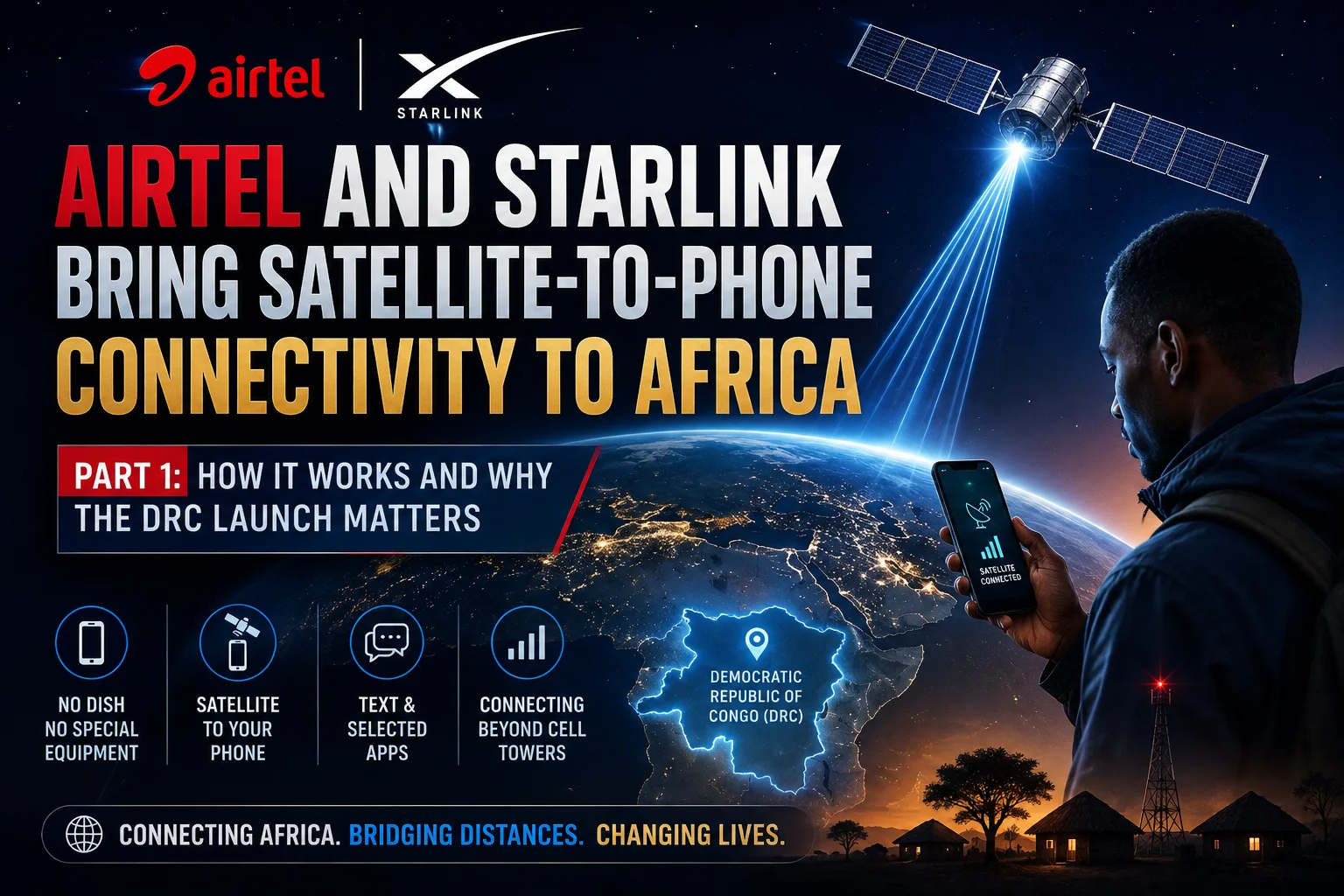
On 14 August 2026, Airtel Africa and SpaceX’s Starlink commercially launched a satellite-to-mobile service in the DRC. The companies describe it as Africa’s first commercial deployment of Starlink Mobile. Instead of requiring a Starlink dish, router or separate satellite phone, the service allows eligible Airtel customers with compatible smartphones to connect directly to Starlink satellites when they are outside conventional terrestrial mobile coverage.
A mobile phone that loses contact with a tower may increasingly be able to look upward instead—connecting to a satellite that behaves, in important respects, like a cell tower in space.
What Exactly Happened in the DRC?
Airtel Africa and Starlink moved their Direct-to-Cell partnership from testing into commercial service in the Democratic Republic of the Congo. According to reports on the launch, eligible customers can use compatible LTE Android smartphones to access the satellite layer in places where Airtel’s normal terrestrial network is unavailable.
The initial service is deliberately limited. It supports SMS and selected light-data applications, including WhatsApp messaging. It should not be confused with unrestricted high-speed Starlink broadband, nor should users expect it to behave like a strong urban 4G or 5G connection.
That limitation is important because “satellite-to-phone” can easily create the wrong expectation. The first commercial value is not necessarily watching high-definition video from the middle of a forest. It is being able to send a message, communicate basic information or remain reachable where a conventional mobile signal would otherwise be absent.
This Is Not the Starlink Service Most Africans Already Know
Traditional Starlink broadband and Starlink Direct to Cell solve related problems in very different ways.
The familiar Starlink internet service uses dedicated customer equipment—a satellite terminal or dish, power supply and usually a Wi-Fi router. The terminal communicates with the Starlink constellation and distributes internet connectivity to devices around it.
Direct to Cell removes that dedicated terminal from the user experience. SpaceX equips particular Starlink satellites with cellular technology designed to communicate with ordinary compatible LTE devices. Starlink describes these satellites as effectively functioning like cell towers in space and says the system integrates with participating mobile operators in a way comparable to a roaming partner.
That difference is profound. A satellite terminal is equipment you deliberately install. Direct-to-phone connectivity is intended to become an extension of the mobile network already associated with the device in your pocket.
How Can an Ordinary Smartphone Reach a Satellite?
A conventional mobile phone is designed primarily to communicate with terrestrial base stations, not spacecraft moving hundreds of kilometres above the Earth. Direct-to-cell engineering therefore has to solve difficult problems involving signal strength, antenna capability, satellite movement, timing and Doppler shift.
SpaceX says its Direct-to-Cell satellites use advanced cellular modems, phased-array antennas, custom technology and software to provide LTE connectivity to existing cellular devices. In practical language, the satellite carries equipment that allows it to participate in the mobile-network architecture rather than requiring the consumer to carry a traditional satellite handset.
The user experience is consequently much closer to mobile roaming than to installing satellite broadband equipment.
What Can Airtel Customers in the DRC Actually Do Today?
At launch, the service is aimed at basic communication rather than full broadband replacement. Reports say compatible Android LTE devices can use SMS and selected lightweight data services, including WhatsApp messaging, when terrestrial coverage is unavailable.
Customers need an active Airtel DRC data bundle or appropriate roaming capability. Device eligibility matters: owning an Airtel SIM does not automatically mean every handset can use the satellite service immediately.
Why the DRC Is a Powerful Place to Demonstrate the Idea
The DRC is vast. Its forests, difficult terrain, dispersed communities and infrastructure challenges make universal terrestrial coverage exceptionally difficult. In such an environment, the economics of installing and maintaining towers can become unfavourable long before the social need for connectivity disappears.
This is precisely where satellite-to-mobile technology becomes interesting. It does not require a tower to be constructed beside every person who needs a basic connection. The satellite layer can extend the reach of the operator into areas that terrestrial infrastructure has not yet covered.
That does not make towers obsolete. Dense cities and high-traffic areas still need the capacity, economics and performance of terrestrial networks. Satellite connectivity is better understood as another layer—especially valuable where the terrestrial layer becomes unavailable.
The Partnership Did Not Begin in August 2026
The DRC launch is the commercial result of a broader Airtel Africa–SpaceX strategy. Airtel Africa announced its strategic Direct-to-Cell partnership with SpaceX in December 2025, with plans to extend the technology across Airtel’s African markets subject to country-specific regulatory approvals.
In March 2026, Airtel Africa announced successful Starlink Mobile data and messaging tests in Kenya. Those tests took place in locations without Airtel terrestrial coverage, demonstrating the intended role of the satellite network as an extension of the existing mobile footprint.
The DRC is therefore important not because it appeared suddenly, but because it represents the transition from partnership announcement and technical testing to a service that ordinary eligible customers can actually use.
Why This Matters for Rural Africa
Africa’s connectivity challenge is not simply about national coverage percentages. A country may report broad population coverage while still containing enormous geographic dead zones.
Farmers work far from towns. Trucks cross long highways. Health workers travel into remote communities. Mining operations exist in isolated locations. Fishing communities move across water. Humanitarian organisations operate where infrastructure may be weak or damaged.
Satellite-to-phone technology changes the question from “Can we economically build a tower here right now?” to “Can the existing mobile customer remain basically connected here through another layer of the network?”
Five Areas Where the Technology Could Be Transformative
1. Agriculture
Basic satellite connectivity could support communication with buyers, cooperatives, transporters, extension workers and family members when terrestrial coverage disappears.
2. Transport and Logistics
Even limited messaging can be valuable for reporting delays, requesting assistance, sharing location information or coordinating deliveries along poorly covered routes.
3. Healthcare
Remote health workers do not always need fibre-like speeds to gain value from connectivity. The ability to exchange messages and essential information from an uncovered area can itself matter.
4. Humanitarian and Emergency Communication
Floods, conflict, storms and other emergencies can damage terrestrial infrastructure precisely when communication becomes most important. A satellite layer creates a different physical path to the network.
5. Mining, Energy and Remote Enterprise
Satellite-to-mobile services could complement the more capable communications systems already used by enterprises by extending basic personal connectivity to workers across wider areas.
Part 1 Conclusion: A New Layer of the Mobile Network
The DRC launch should not be exaggerated into the end of terrestrial telecommunications. Its importance is subtler and potentially more durable: the mobile network is acquiring an orbital extension.
Part 2 of this ODS Knowledge Centre series examines the question that matters especially to Nigerian readers: Could this come to Nigeria, what would it change, what are its limitations, and what should businesses, regulators and consumers watch next?
Comments
Join the Discussion
Comments are reviewed before publication.