
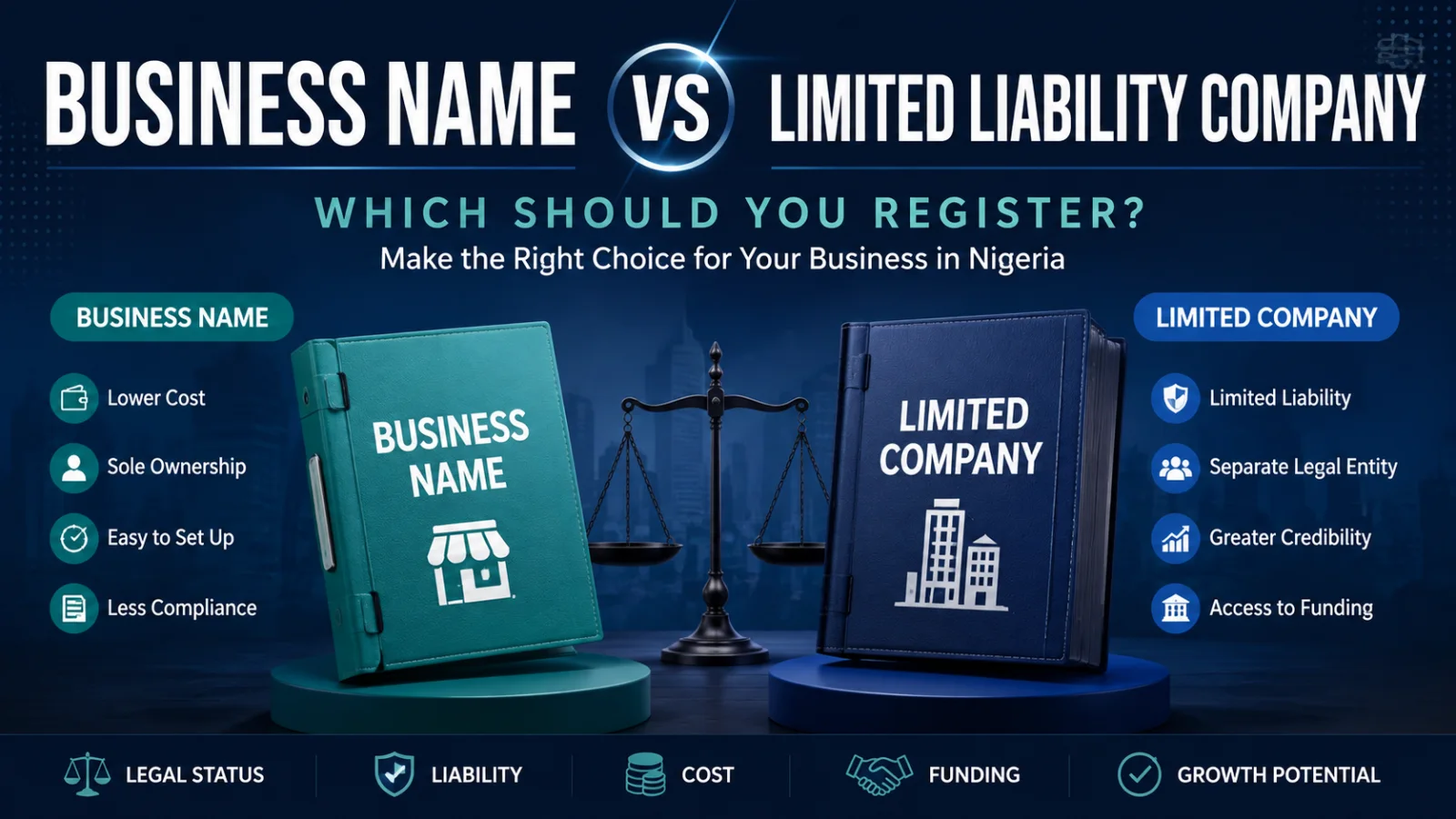
For many Nigerian entrepreneurs, the first serious legal decision is not choosing a logo or opening a social-media page. It is deciding what kind of business they are actually building.
That decision often appears in a simple form: Should I register a Business Name, or should I incorporate a Limited Liability Company?
The choice is not merely about registration cost. It affects ownership, risk, governance, investment, continuity and the amount of formal compliance that follows. A Business Name and a private company limited by shares are both recognised within Nigeria's corporate-registration framework, but they are different legal arrangements.
The right question is not “Which certificate is better?” It is “Which structure fits the business I intend to build?”
The Short Answer
If you are starting a relatively simple owner-managed venture—such as a freelance practice, small retail operation, consultancy, artisan business or early-stage service enterprise—a Business Name may provide the formal trading identity you need without immediately creating a full corporate structure.
If you are building an enterprise expected to have shareholders, formal ownership percentages, investors, substantial contracts, significant assets or long-term institutional ambitions, a private company limited by shares deserves serious consideration from the beginning.
What Exactly Is a Business Name?
CAMA 2020 defines a business name as the name or style under which a business is carried on, whether in partnership or otherwise. In practical terms, it is commonly used by a sole proprietor or partners who want to operate under a registered commercial name.
CAC's current Business Name process is end-to-end online. It involves checking name availability, completing the pre-registration form, uploading the relevant documents and paying the applicable filing fee. CAC states that successful registration produces an electronic Certificate of Registration and Certified Extract. Individual proprietors can also register a Business Name without retaining a lawyer, chartered accountant or chartered secretary.
What Exactly Is a Limited Liability Company?
A private company limited by shares is an incorporated company governed by CAMA. Its ownership is expressed through shares, and its management is carried out through directors within a formal corporate framework.
One important feature of CAMA 2020 is that one person may form and incorporate a private company. A solo founder therefore does not have to invent a second shareholder merely to incorporate.
CAC's current company-registration process involves preliminary name availability, formal name reservation, digital pre-registration, supporting documentation, payment of filing and applicable statutory charges, and electronic incorporation documents after approval.
Business Name vs Limited Company: Practical Comparison
| Issue | Business Name | Private Limited Company |
|---|---|---|
| Nature | Registered trading name or style | Incorporated company |
| Typical owners | Proprietor or partners | Shareholder or shareholders |
| Ownership percentages | Can be agreed privately, but not represented as company shares | Expressed through share ownership |
| Management | Usually proprietor or partners | Directors |
| Investor readiness | Less suited to equity investment | Better structured for equity participation |
| Governance | Usually simpler | More formal corporate governance |
| Best fit | Simple owner-managed businesses | Businesses designed for scale, investors or formal ownership |
1. The Legal Structure Is Different
CAMA places Business Names in a separate part of the Act from incorporated companies. A Business Name identifies the name under which the proprietor or partners carry on business. A company is created through incorporation under the company provisions of CAMA.
That difference affects ownership, management, continuity and how outsiders understand the entity. A proprietor should therefore never describe a Business Name as though it were a limited company. If “Bright Future Ventures” is registered only as a Business Name, it should not casually be represented as “Bright Future Ventures Ltd”.
2. Ownership: Proprietors and Partners vs Shareholders
With a Business Name, ownership is usually straightforward. One proprietor may own the business, or partners may carry it on together.
A company introduces a formal share structure. That becomes valuable where founders contribute different amounts, ownership percentages matter, investors may come in, or succession and transfer of ownership need to be documented clearly.
If equity is central to the business plan, a company provides the cleaner legal architecture.
3. A One-Person Company Is Possible
Some entrepreneurs still believe they must find another person to become a shareholder before registering a private company. CAMA 2020 expressly permits one person to form and incorporate a private company, subject to the requirements of the Act.
This matters for solo founders who want a formal company structure without creating an artificial ownership arrangement.
4. Liability and Commercial Risk
A company limited by shares is built around limited liability. That is materially different from carrying on business merely under a Business Name.
But “limited liability” should not be marketed as a magic shield. Personal guarantees, fraud, unlawful conduct, certain regulatory breaches or obligations personally undertaken can still create personal exposure.
The practical lesson is that the more contractual, operational or financial risk a business is expected to carry, the more carefully its legal structure should be considered before registration.
5. Investment and Bringing New Owners In
If you expect outside investors, a company structure can become extremely useful because ownership can be represented through shares. An investor can ask: What percentage am I acquiring? What rights attach to my shares? Who else owns the company? How can ownership change?
A Business Name does not offer the same equity framework. Partners may agree on profit-sharing and ownership arrangements, but that is not the same as corporate share ownership.
6. Directors and Day-to-Day Management
A Business Name is usually managed directly by the proprietor or partners. A company introduces directors, creating a clearer distinction between ownership and management.
For a tiny business that distinction may initially feel unnecessary. For a growing enterprise it can become valuable because shareholders do not necessarily have to manage every operational function personally.
7. Credibility: Avoid the Lazy Argument
It is common to hear that a limited company is automatically “more credible” than a Business Name. That is too simplistic.
A properly registered Business Name is a legitimate registered business. CAC itself promotes registration because it makes businesses verifiable and supports formal transactions. At the same time, commercial perception is real: some institutional clients, investors, procurement processes and regulated activities may prefer or require an incorporated company.
The question is not whether one structure has dignity and the other does not. The question is whether the structure satisfies the market you intend to serve.
8. Banking and Financial Relationships
CAC identifies formal banking and business transactions among the benefits of registration. Both Business Names and companies can participate in formal financial relationships, subject to the requirements of the particular bank or financial institution.
A company's formal ownership and governance records may, however, become increasingly useful where there are several shareholders, directors, authorised signatories, borrowing arrangements or external investors.
9. Contracts, Procurement and Institutional Clients
A neighbourhood retailer and a technology company bidding for a major implementation contract do not have the same commercial needs.
Before choosing a structure, think about the counterparties you expect to deal with. Some tenders, contracts or regulated sectors specify entity requirements. If your strategy includes government procurement, major corporate clients, international counterparties, external investment, significant borrowing or joint ventures, a company may provide the more appropriate foundation.
10. Growth and Continuity
Many businesses begin as extensions of the founder. That is normal. But if the intention is to build an institution, the structure eventually has to accommodate people beyond the founder.
A company is naturally suited to questions such as: Who owns the organisation? Who manages it? How can ownership change? What happens when a director leaves? How are major decisions approved?
If those questions are likely to become important soon, incorporating earlier may avoid disruptive restructuring later.
11. Compliance: Simpler Does Not Mean “No Compliance”
A Business Name is generally simpler to administer than a company, but registration is not the end of compliance. Companies carry a broader formal framework involving directors, shareholders, share capital, registered-address records, annual returns and other post-incorporation filings.
CAC's current service-timeline page separately lists company post-registration services for changes in directors, shareholders, registered address, share capital, PSC information and annual returns.
12. Registration Process: Business Name
CAC currently describes the Business Name process in three broad stages:
- check availability of the proposed name;
- complete the Business Name pre-registration form and upload the relevant documents through the portal; and
- pay the applicable filing fee.
The process is end-to-end online and successful registration produces electronic registration documents.
13. Registration Process: Limited Liability Company
The current company-registration journey is more structured. CAC directs applicants to perform preliminary name availability, reserve the selected company name, complete digital pre-registration, submit supporting documentation, pay filing and applicable statutory stamp-duty charges, and obtain the electronic Certificate and Certified Extract after approval.
14. Registration Time Should Not Decide the Structure
CAC's revised service timelines currently show a 24-working-hour target for both new companies and new Business Names after receipt of all relevant documents or compliance with any query.
That is a service target, not a guarantee that every application will finish in exactly one day. More importantly, speed should not determine legal structure. Choosing the wrong structure quickly is still choosing the wrong structure.
15. What About Cost?
A Business Name is generally the simpler registration. Company incorporation includes company-specific filing requirements and applicable statutory charges. But current fees should be checked on the official CAC platform when filing because charges can change and company costs may depend on the particulars of the incorporation.
Choose the structure first. Confirm the current cost second.
16. Three Realistic Scenarios
Scenario A: The Solo Service Provider
Amaka is a freelance event decorator. She works alone, has modest operating risk, does not intend to raise equity and mainly needs a formal name for invoices, marketing and business transactions. A Business Name may be entirely reasonable for her present circumstances.
Scenario B: The Two-Founder Technology Business
Tunde and Chinedu are developing a software platform. One is contributing capital while the other contributes the product and technical work. They expect to seek investors. A company structure deserves serious consideration because ownership percentages and equity investment matter from the beginning.
Scenario C: The Small Business With Institutional Ambition
Bola runs a growing food-processing operation. Today she owns it alone, but within three years she wants a factory, staff, supermarket contracts and financing. She could begin with a Business Name, but she should ask whether the business she intends to become justifies incorporation now.
17. When a Business Name Is Often a Sensible Choice
- one person or a simple partnership owns and directly manages the business;
- there is no immediate plan to raise equity investment;
- ownership does not need to be represented through shares;
- commercial risk is relatively modest;
- the founder wants a straightforward formal trading identity; and
- clients or regulators do not require an incorporated company.
18. When a Limited Company Deserves Serious Consideration
- multiple owners need defined equity percentages;
- investors may acquire ownership;
- the business will hold significant assets;
- substantial contracts or financial risks are expected;
- management needs to become distinct from ownership;
- the enterprise is intended to continue beyond the founder; or
- the owners are deliberately building for scale.
19. Common Mistakes to Avoid
Choosing solely because a friend registered the same structure
Two businesses in the same industry can have completely different ownership, risk and growth plans.
Choosing solely because one registration is cheaper
The cheapest filing today can become expensive if the business has to be reorganised soon afterwards.
Adding an “investor” informally to a Business Name
If someone is contributing capital in exchange for ownership, the relationship should be documented properly and the legal structure reviewed.
Registering a company but ignoring it after incorporation
A company is not merely a certificate. Corporate records and statutory filings have to be maintained.
Assuming limited liability removes every personal responsibility
It does not. Personal guarantees, fraud, unlawful conduct and other personal obligations may still matter.
20. Questions to Answer Before You Register
- Am I the only owner?
- Will another person own part of the business?
- Do we need clearly stated ownership percentages?
- Will we seek investors?
- What level of commercial risk will we take?
- Will we enter major or long-term contracts?
- Will the business acquire significant assets or borrowing?
- Do our target customers expect an incorporated company?
- Is the sector regulated in a way that affects entity choice?
- Do I want the organisation to continue independently of my daily involvement?
- Am I ready to maintain company records and filings?
- Where do I realistically expect the business to be in five years?
Those questions are more useful than asking which certificate looks more impressive.
Frequently Asked Questions
Is a Business Name the same as a limited company?
No. They are separate registration structures. A Business Name is the name or style under which business is carried on; a limited company is incorporated under the company provisions of CAMA.
Can one person register a private company?
Yes. CAMA 2020 permits one person to form and incorporate a private company, subject to compliance with the Act.
Does a Business Name have shareholders?
Not in the company-law sense. A Business Name may have a proprietor or partners. A company limited by shares has shareholders and a share-capital structure.
Can a Business Name open a business bank account?
A registered Business Name can participate in formal banking relationships, subject to the current requirements of the relevant financial institution.
Which one is faster to register?
CAC's current service timeline lists a 24-working-hour target for both new companies and new Business Names after all relevant documents are received or any query has been complied with.
Can I start with a Business Name and incorporate later?
A business can be restructured as circumstances change, but the transition should be planned carefully because contracts, assets, banking arrangements, tax records, branding and ownership relationships may need to be reorganised.
Our Practical Conclusion
A Business Name is not an inferior version of a company. A limited company is not automatically the correct answer for every entrepreneur.
The Business Name is useful because it provides a straightforward way to formalise an owner-managed business under a registered trading name. The limited company is powerful because it provides a formal corporate structure built around shares, directors, governance and incorporation.
If you are running a simple enterprise with no immediate need for investors, formal equity or complex governance, a Business Name may serve you well. If you are deliberately building an organisation that will have shareholders, investors, substantial contracts, a management structure and long-term institutional ambitions, a private limited company should be evaluated seriously before you file.
Do not register merely for today's business. Register with a clear understanding of the business you are trying to become.
Need Assistance With CAC Registration?
Opensource Digital Services Limited provides digital business-registration and corporate-support services for entrepreneurs, companies and organisations. Where a proposed transaction raises legal, tax, investment or regulatory issues, appropriate professional advice should be obtained before the structure is finalised.
Official Sources and Further Reading
- Corporate Affairs Commission — Business Name Registration
- Corporate Affairs Commission — Company Registration
- Corporate Affairs Commission — About / Why Register
- Corporate Affairs Commission — Revised Service Timelines
- Companies and Allied Matters Act, 2020 — Official CAC-hosted copy
This article is intended for general information and business education. It is not legal, tax, investment or regulatory advice. CAC procedures, fees and sector requirements may change.

Comments
Join the Discussion
Comments are reviewed before publication.