
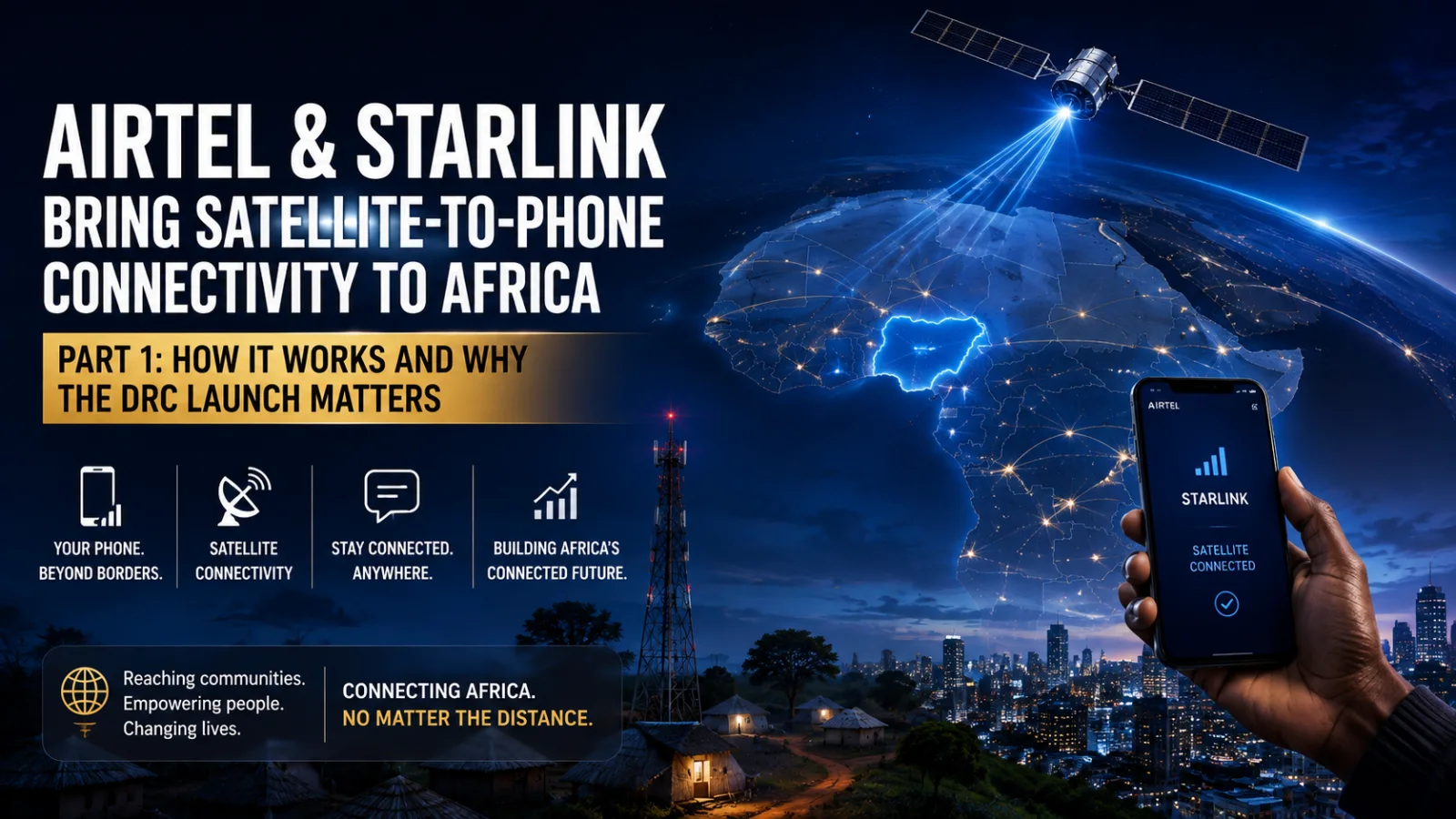
The commercial launch of Airtel Africa and Starlink’s satellite-to-phone service in the Democratic Republic of the Congo raises an obvious question for the rest of the continent: who comes next?
For Nigerian readers, the question is particularly important. Nigeria is one of Africa’s largest telecommunications markets, and Airtel operates at national scale. But the DRC launch must be interpreted carefully. A continental partnership does not mean the service is already commercially available in every Airtel market.
The DRC proves that the technology can move from announcement to testing and then to commercial African deployment. It does not prove that Nigerian subscribers can use it today.
Could Satellite-to-Phone Connectivity Come to Nigeria?
Nigeria is part of Airtel Africa’s wider operating footprint covered by the strategic Starlink Direct-to-Cell partnership. However, rollout into individual countries depends on local regulatory, spectrum, technical and commercial arrangements.
Therefore, Nigerian Airtel subscribers should not interpret the DRC announcement as confirmation that their phones can already connect to Starlink Direct to Cell in Nigeria.
What the launch demonstrates is that the technology has progressed beyond a concept. If the required Nigerian approvals and commercial arrangements are completed, Nigeria could become part of the wider rollout envisaged by the partnership.
What Could It Mean for Nigeria?
The greatest value would probably not be in densely connected parts of Lagos, Abuja or Benin City. Terrestrial networks already carry enormous volumes of traffic in such locations. The more compelling use case is at the edges of coverage.
Imagine a traveller whose phone loses terrestrial service on a remote road but can still send a message. Imagine agricultural communities gaining a basic communication layer without waiting for dense tower deployment. Imagine disaster-response teams retaining some connectivity after local infrastructure is disrupted.
Those are the kinds of situations that make direct-to-cell strategically interesting.
Will Starlink Replace Mobile Towers?
No—not on the evidence of how the technology is currently being deployed.
Terrestrial towers offer major advantages in capacity, spectrum reuse, performance and economics in populated areas. A satellite covering a large geographic footprint cannot simply replace the dense terrestrial infrastructure required to serve millions of people simultaneously in a major city.
The stronger model is hybrid connectivity:
Terrestrial network where terrestrial infrastructure works well; satellite extension where it does not.
The strategic value lies in extending the network, not demolishing the existing one.
Will You Need a Starlink Dish?
For Direct to Cell, the absence of a separate Starlink dish is one of the defining features. Compatible smartphones communicate directly with the satellite layer.
This should not be confused with Starlink home or business broadband, which uses dedicated Starlink equipment and is designed for a different connectivity experience.
Will Every Smartphone Work?
Not necessarily. Although Direct to Cell is designed around existing LTE technology, commercial operators can have device-compatibility, software, network and service-plan requirements.
In the DRC launch, initial access has been reported for compatible LTE Android smartphones, with wider device support expected. Consumers should rely on official operator eligibility information rather than assuming that any 4G handset will immediately connect.
Is This Full Satellite Internet on Your Phone?
Not in the sense many consumers will imagine.
The initial DRC service focuses on SMS and selected light-data applications. That is very different from promising unrestricted high-speed browsing, HD video streaming and the full experience of a strong terrestrial broadband connection.
Starlink’s longer-term Direct-to-Cell roadmap is broader, including data, IoT and voice capabilities. But what the technology may ultimately support and what an operator offers commercially in a particular country are not the same thing.
The safest consumer rule is simple: judge the service by the operator’s current published capabilities.
The Regulatory Question Is as Important as the Satellite
Satellites cross borders effortlessly. Telecommunications regulation does not.
Mobile services depend on licensed spectrum, national communications rules, operator authorisations and other regulatory conditions. This is why a multi-country partnership cannot simply be switched on across Africa simultaneously.
For Nigeria, national regulatory and spectrum arrangements will be central to any future commercial launch.
Affordability May Decide Whether the Revolution Reaches Ordinary People
Technological possibility does not automatically produce digital inclusion.
A service can cover a remote village from space and still fail to transform lives if the compatible phone is unaffordable or the service plan costs too much.
The strongest version of this technology is not merely one that technically reaches remote Africans; it is one they can realistically afford to use when they need it.
There Is Also a Device Divide
Direct-to-cell technology reduces the need for specialist satellite hardware, which is a major advantage. But it does not remove the smartphone affordability problem.
People living in the least-connected communities may also be among those least able to purchase newer compatible smartphones and recurring data bundles. Policy discussions around rural connectivity therefore still need to include device affordability, digital skills, electricity and local economic opportunity.
What This Means for African Telecom Operators
The satellite era does not necessarily put mobile operators and satellite companies on opposite sides. Airtel’s partnership demonstrates an integration model.
The mobile operator contributes customer relationships, spectrum arrangements, billing, local market operations and terrestrial infrastructure. The satellite operator contributes an orbital layer capable of reaching places that towers do not.
This could reshape competition around a new question: not merely “Who has the most towers?” but “Who can provide the most continuous connectivity across terrestrial and non-terrestrial networks?”
What This Means for African Businesses
Reliable communication outside traditional coverage has implications for logistics, agriculture, field services, construction, mining, energy, healthcare and disaster management.
Over time, direct-to-cell IoT connectivity could become equally important. Sensors, vehicles, machinery and other devices operating beyond terrestrial coverage could potentially remain connected through the satellite layer, depending on commercial availability and technical support.
For African digital businesses, this may create opportunities around applications designed for intermittent or low-bandwidth connectivity, field operations, location services, remote workforce tools and resilient communications.
The Bigger Shift: Connectivity Is Becoming Multi-Layered
Consumers have traditionally thought about mobile networks, fibre, Wi-Fi and satellite internet as separate systems. The next phase increasingly combines them.
A phone may use Wi-Fi indoors, 4G or 5G from a terrestrial tower outdoors, and a satellite connection when both disappear. Ideally, the consumer should not need to understand the network engineering behind every transition.
That is why the DRC launch matters beyond the number of people who use it in its first month. It is evidence of a telecommunications architecture in which space-based infrastructure can become part of an ordinary mobile operator’s coverage strategy.
What the Technology Cannot Solve by Itself
Satellite-to-phone connectivity cannot by itself solve:
- the cost of smartphones;
- the affordability of mobile data;
- digital literacy;
- electricity shortages;
- congestion in dense urban networks;
- national spectrum and licensing questions;
- the need for fibre backbones and data centres; or
- the need for continued terrestrial network investment.
Its great strength is more specific: it can help reduce the places where losing terrestrial coverage means losing communication completely.
Five Questions Africa Should Watch Next
- Which Airtel Africa market comes next?
- What will the service cost after introductory access?
- How quickly will device compatibility expand?
- How much capacity will future Direct-to-Cell satellites provide?
- How will African regulators approach spectrum, competition and consumer protection?
Frequently Asked Questions
Is Starlink Direct to Cell already available on Airtel Nigeria?
The DRC is the commercial African launch discussed in this series. Nigerian availability should be treated as unconfirmed until Airtel Nigeria and the relevant authorities announce commercial service.
Does Direct to Cell need a Starlink dish?
No separate Starlink dish is required for compatible smartphones using the Direct-to-Cell service.
Will satellite-to-phone replace 4G and 5G?
It is more likely to complement terrestrial networks, particularly beyond their coverage footprint.
Why should businesses care?
Because more continuous connectivity could improve communications for field workers, logistics, agriculture, remote operations, emergency response and eventually connected devices operating beyond terrestrial coverage.
ODS Knowledge Centre Perspective
The most important lesson from the DRC is not that Africa has suddenly solved its connectivity problem. It has not.
The significance is that the technological toolbox has expanded.
For decades, reaching an uncovered community usually meant extending terrestrial infrastructure towards it. That remains essential. Direct to Cell adds another possibility: extend part of the mobile network from orbit.
If the model proves affordable, scalable and regulatorily workable across Airtel Africa’s other markets, it could change what Africans mean when they say they are “out of network coverage.” The phrase may no longer always mean complete disconnection.
For Nigeria, the development should be watched carefully rather than prematurely celebrated as a locally available service. The DRC has demonstrated that the commercial model can move from announcement to reality in an African market.
The future of African connectivity may not be terrestrial or satellite. Increasingly, it may be both.
Continue the Series
This is Part 2 of the ODS Knowledge Centre analysis. Readers who have not read Part 1 should begin with “How It Works and Why the DRC Launch Matters” for the technology, DRC launch and rural-connectivity background.
This series is independent ODS Knowledge Centre analysis based on publicly available company statements and reporting current at 16 August 2026. Service availability, compatible devices, pricing and regulatory approvals can change. Readers should confirm current commercial availability with the relevant mobile operator.
Comments
Join the Discussion
Comments are reviewed before publication.